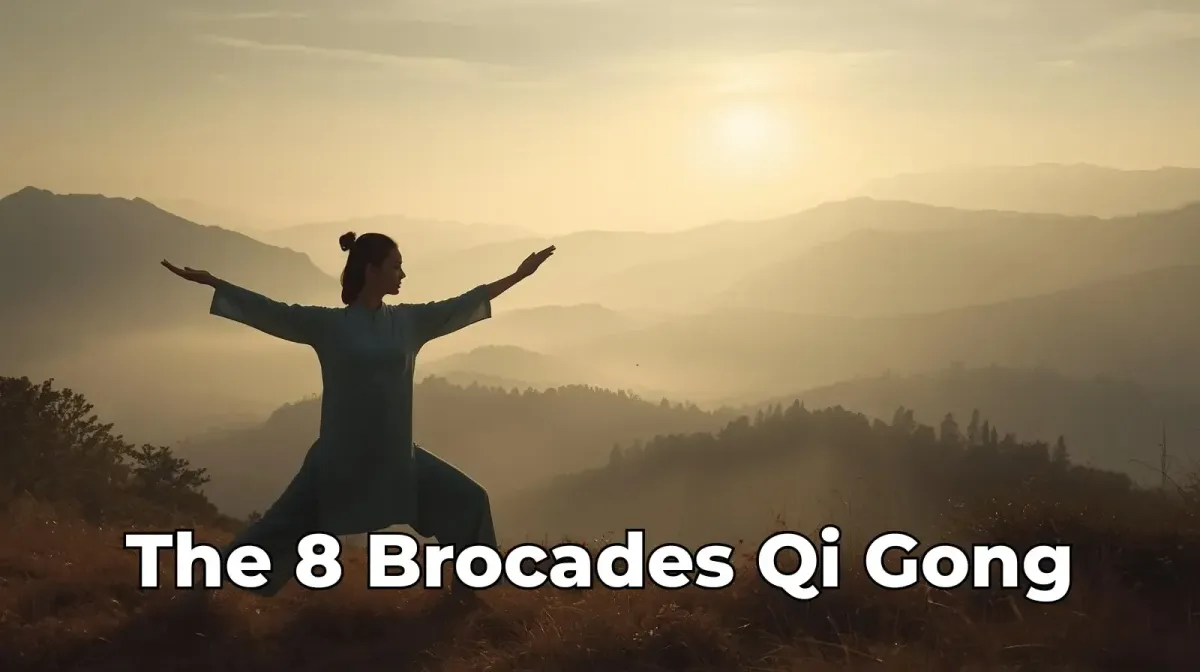
Eight Brocades (Ba Duan Jin): A Gentle Starter Guide
If you’re new to Qi Gong, Eight Brocades (Ba Duan Jin) is one of the kindest places to begin. It’s simple. It’s rhythmic. It meets you where you are. In this guide, you’ll learn what it is, why it’s loved, how to practise safely, and an easy beginner routine you can follow today—without overwhelm.
Learn Qi Gong at home at the Bright Beings Academy

What is Eight Brocades?
Eight Brocades is a classic Chinese health-Qi Gong set made up of eight flowing movements. Each one gently opens different parts of the body while calming the breath and mind. The sequence has a long cultural history, with versions documented for centuries and commonly taught today as a health-focused, accessible routine. It’s popular because the patterns are easy to remember, require no equipment, and scale beautifully for all fitness levels. (Wikipedia)
Think of it as an evenly balanced practice. You’ll mobilise the spine and shoulders, wake up the hips and legs, and settle nervous-system arousal with longer, softer exhales. Done regularly, it becomes a moving meditation—steady, warm, and quietly uplifting.
Benefits at a glance (realistic, gentle)
Research on Ba Duan Jin points to meaningful but modest improvements across several health markers when practised consistently. Reviews and trials report signals for better sleep quality, balance and mobility in older adults, blood-pressure support in hypertension, and symptom improvements in some musculoskeletal conditions. Safety profiles are generally favourable when taught sensibly and paced well. (ScienceDirect)
A kind reminder: Qi Gong is not a quick fix. It’s a gentle habit that helps the body settle and heal over time.
Safety first (please read once)
Move within comfort. No straining.
Keep knees soft and aligned over toes, especially in bends and squats.
Breathe light and quiet, with a longer exhale.
If you feel dizzy, nauseous, breathless, or distressed, stop and rest.
Recent injury, surgery, uncontrolled health conditions or pregnancy? Speak to a clinician and adapt as needed.
Adverse events in studies are uncommon and usually mild (e.g., temporary muscle ache); monitor your response and pace yourself. (PMC)
Who it’s for (and not for)
Great for: beginners, desk-bound bodies, older adults, stressed nervous systems, and anyone wanting a daily ritual that takes 10–15 minutes.
Use with care: acute knee/back issues, uncontrolled hypertension, dizziness, or balance disorders—adapt range, use a chair, and practise near support.
Not ideal today: fever, illness flare, or when your body clearly asks for stillness; rest first.
The Eight (plain-English names)
You’ll find different translations. Here are friendly names to remember:
Lift the Sky — lengthen through crown, open ribs.
Draw the Bow — expand chest, spiral gently.
Separate Heaven & Earth — one hand up, one down; lengthen sides.
Look Back — soft neck/eye turns, ease tension.
Sway the Head & Shake the Tail — release spine/hips.
Two Hands Hold the Feet — forward fold variation, hamstrings/back line.
Clench the Fists, Gaze Fiercely — stable stance, soft power.
Bounce on the Heels — wake up fascia and circulation.
Each can be performed in micro-ranges. Keep movements small and comfortable at first; depth is never the goal.
A 12-minute Eight Brocades (Beginner) — step-by-step
Set-up: Feet hip-width. Knees soft. Crown tall. Tongue lightly on the roof of the mouth. Breathe in through the nose for 4, out for 6–8.
0:00–1:00 | Arrive
Shake out wrists, elbows, shoulders. Soften jaw. Three slow breaths, lengthening the exhale.
1:00–2:30 | 1. Lift the Sky
Hands float up, palms to sky; exhale as palms turn and glide down. 6 slow reps. Feel ribs widen; avoid shrugging.
2:30–4:00 | 2. Draw the Bow
Step a little wider. Imagine drawing a bow to one side. Eyes follow the “arrow”, then return to centre. 3 reps each side. Keep shoulders low.
4:00–5:30 | 3. Separate Heaven & Earth
One palm presses up, the other down. Long sides, soft spine. 6 slow reps, alternating sides. Keep breath quiet.
5:30–6:45 | 4. Look Back
Hands rest on hips or float at sides. Turn head and eyes gently left, then right. 5 slow turns each way. No forcing.
6:45–7:45 | 5. Sway the Head, Shake the Tail
Knees soft, pelvis draws small figure-eights. 60 seconds of smooth circles. Relax your lower back.
7:45–9:00 | 6. Two Hands Hold the Feet
Slide palms down thighs toward shins; only as far as comfy. Exhale longer as you fold; inhale to rise. 6 gentle reps. Micro-bend the knees.
9:00–10:30 | 7. Clench the Fists, Gaze Softly
Lightly close fists (no tension). Sink weight, spine tall. Exhale as arms extend softly; inhale to gather. 6 slow reps. Keep face relaxed.
10:30–11:15 | 8. Bounce on the Heels
Rise on balls of feet and softly let heels meet the floor (or tiny pulses). 45 seconds. Skip this if you have bone health concerns.
11:15–12:00 | Close
Hands over lower abdomen. Breathe 4-in, 6–8-out. Stroke down the arms and legs. Small bow. Notice the calm.
Knee care: keep knees tracking over the middle toes, especially in #2 and #7. Lower range beats deeper range.
Breath cue: if 4/6 feels edgy, try 3/5. Comfort is king.
Common mistakes (and quick fixes)
Shoulders creep up. Imagine your shoulder blades sliding into warm pockets.
Breath gets forceful. Less effort. Treat breath like steam on a winter window.
Neck strain in “Look Back”. Keep turns small, lead with the eyes.
Rushing. Slow it down. Each rep takes one full cycle of breath.
Pushing depth. Ease wins. Range grows naturally when the body trusts you.
A simple 4-week progression
Week 1: Learn shapes. Keep reps low. 8–10 minutes most days.
Week 2: Settle rhythm. Add the longer exhale and smoother transitions.
Week 3: Extend to 12–15 minutes. Notice which movements calm you most.
Week 4: Personalise. Shorten or repeat favourites. Explore a seated version on lower-energy days.
This is where transformation lives: small, kind, repeatable.
Join Bright Beings Academy
Want guidance, structure, and live encouragement? Join Bright Beings Academy and follow our step-by-step Eight Brocades lessons inside the member library—plus weekly live classes to keep you steady. Membership options below.
Evidence snapshot (what studies suggest)
Sleep & recovery: A 2024 meta-analysis found Baduanjin improved sleep in older adults, measured by PSQI. Real-world takeaway: evening or late-afternoon practice can support sleep when done consistently. (ScienceDirect)
Balance, mobility & posture: Reviews in older adults and clinical groups report gains in balance, motor function, and postural stability when programmes are followed for several weeks. (BMJ Open)
Blood pressure: Recent evaluations and meta-analyses suggest Baduanjin supports systolic/diastolic reductions in essential hypertension over 3–6 months—best seen with steady frequency. Use alongside medical care. (PubMed)
Neck/KOA pain (emerging): Early evidence shows potential benefits for neck pain and knee osteoarthritis; quality varies, so keep expectations realistic and practise within comfort. (PMC)
Safety: A 2021 systematic review reported few adverse events across dozens of studies; monitor your own response and pace kindly. (PMC)
What this means for you: Expect steady, modest improvements that compound with practice. Pair your routine with kind lifestyle basics (sleep rhythm, gentle walks, hydration) for best results.
FAQs — Eight Brocades (Ba Duan Jin): A Gentle Starter Guide
How often should I practise?
Little and often is ideal. 10–15 minutes, 4–6 days a week works beautifully. Consistency beats intensity.
Can I do Eight Brocades if I have knee or back pain?
Generally yes, with range reductions and a micro-bend at the knees. Keep spine long, avoid folding deeply, and skip heel-bounces if they jar. If pain persists, stop and seek advice. Evidence for KOA and neck pain is emerging but mixed—go gently. (PubMed)
Is it better in the morning or evening?
Choose your state. Morning for energy and focus; evening for downshifting and sleep. If you’re wired at night, finish 60–120 minutes before bed.
Do I need to memorise all eight straight away?
No. Start with Lift the Sky, Separate Heaven & Earth, and Look Back. Add one new move each week. Progress comes from calm repetition.
Is there seated Eight Brocades?
Yes. Most movements can be adapted to a chair. Keep the breath gentle and the spine tall. The aim is ease, not depth.
Is it safe if I have high blood pressure?
Often yes, when practised softly and alongside your medical plan. The literature suggests supportive effects over months. Avoid breath-holding and straining. (PubMed)
Further reading on Bright Beings Academy
Qi Gong for Beginners: Start Soft, Start Here — Qi Gong for Beginners: Start Soft, Start Here
Morning vs Evening Qi Gong: Which Serves You Best? — Morning vs Evening Qi Gong: Which Serves You Best?
Qi Gong Evidence (2025): What Studies Actually Say — Qi Gong Evidence (2025): What Studies Actually Say
Qi Gong for Blood Pressure: A Gentle Approach — Qi Gong for Blood Pressure: A Gentle Approach
Chair Qi Gong (Office Edition): Calm in 5–10 Minutes — Chair Qi Gong (Office Edition): Calm in 5–10 Minutes
Korean-Style Qi Gong vs Tai Chi: What’s the Difference? — Korean-Style Qi Gong vs Tai Chi: What’s the Difference?
Join Bright Beings Academy
Ready to make Eight Brocades your calm daily ritual? Join Bright Beings Academy below and choose the membership that suits you. I’ll place the membership options block here so you can get started right away.
I look forward to connecting with you in my next post.
Until then, be well and keep shining.
Peter. :)