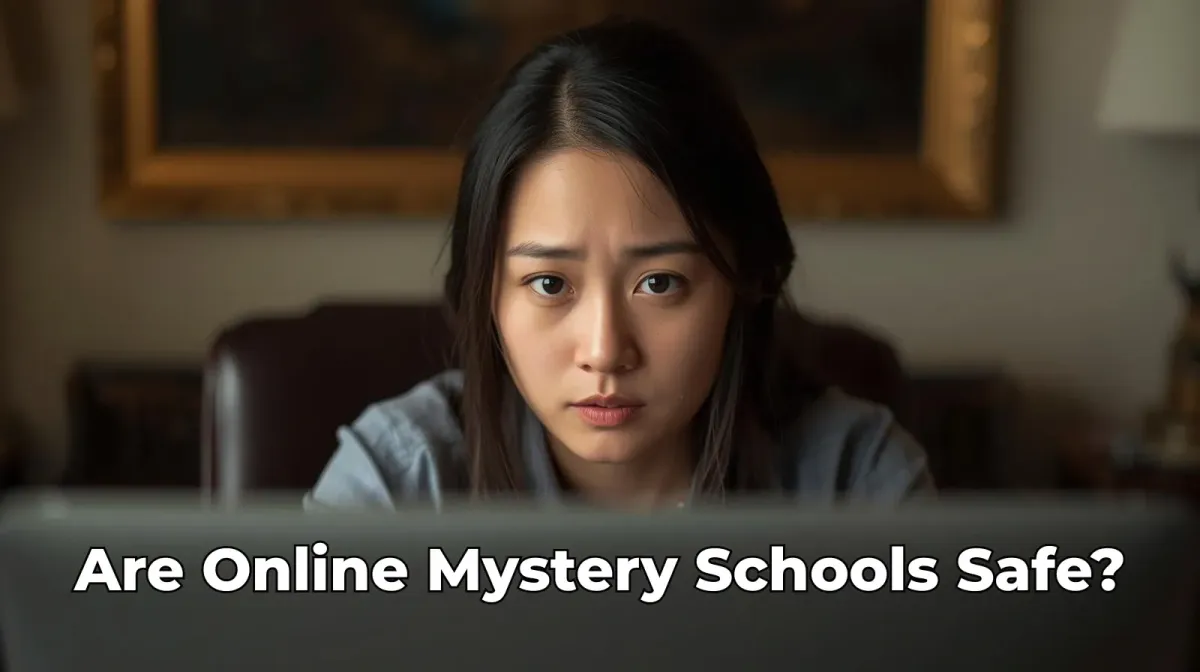
Is This Online Mystery School Safe? A Trauma-Aware Checklist
Finding a mystery school online can feel like stepping into a labyrinth. There are beautiful promises, powerful language and often a real sense of destiny. But if you’re sensitive, carry trauma, or have been hurt in spiritual spaces before, you may find yourself asking a much more basic question:
“Is this actually safe for me?”
This article offers a trauma-aware checklist you can use before, during and after joining any online mystery school. Rather than guessing or relying only on intuition, you’ll have clear questions to ask about ethics, money, power, pacing and your nervous system.
New to mystery schools? Start with our overview article “What Are Mystery Schools?” and then visit the Mystery School hub for classes, courses and next steps.
What do we mean by “trauma-aware” here?
Trauma-aware doesn’t mean a mystery school replaces therapy or becomes a clinical service. It means the people running it:
Understand that many seekers carry unresolved trauma or nervous-system sensitivity
Design practices, language and pacing with that in mind
Avoid shaming, pushing or pathologising natural protective responses
A trauma-aware mystery school treats your body’s signals as information, not obstacles. It gives you real choice and space, rather than using “spiritual” ideas to bulldoze your boundaries.
This checklist is not about judging schools harshly. It’s about helping you recognise where you feel safe enough to do real inner work.
For a fuller map of red and green flags, you might also like Online Mystery Schools: 7 Red Flags and 7 Green Flags and Mystery School vs Cult: How to Tell the Difference (Gently).
How to use this checklist
You can use this checklist at three points:
Before joining – on the website, in taster sessions or emails
In the first month – as you experience the container for real
Every so often – to review whether the school is still a good fit
You don’t have to tick every single box. But if many of the answers are “no” or “I have no idea”, it’s wise to pause, ask questions, or consider other options.
You can literally copy these questions into a note on your phone or journal and fill them in.
1) Ethics and governance checklist
Basic questions:
Can I find a clear code of ethics or conduct on the website?
Is there a named contact for concerns or complaints?
Are there any references to safeguarding, consent or inclusion?
Deeper trauma-aware questions:
Do they explicitly say that harassment, bullying or discrimination are not tolerated?
Is it clear what happens if a boundary is crossed – even by a senior teacher?
Are there multiple people I can speak to if I feel uncomfortable, not just the main leader?
If you can’t find any mention of ethics or complaints routes, that doesn’t automatically mean the group is harmful – but it does mean you’re walking without a clear safety net.
For more context on ethics and red flags, see How to Vet a Mystery School: Ethics, Fees, Promises & Red Flags.
2) Leadership and power checklist
Basic questions:
Is the leader presented as human and fallible, or as an untouchable guru?
Are there other teachers or facilitators, or does everything funnel through one person?
Does the leader ever admit mistakes, change their mind, or respond thoughtfully to feedback?
Deeper trauma-aware questions:
Are there clear boundaries around touch, private sessions, money and personal disclosure?
Is there any hint that the leader has special access to your destiny, karma or soul contract that you yourself cannot access?
Do I feel I can say “no” to the leader without fear of punishment, humiliation or spiritual threats?
If your body tightens at the idea of disagreeing with the leader, take that seriously.
For more on this theme, Mystery School vs Cult: How to Tell the Difference (Gently) goes deeper.
3) Money, promises and pressure checklist
Basic questions:
Are prices and payment plans public and clear?
Is there a refund, cancellation or deferral policy in writing?
Are there honest descriptions of what you get (hours, sessions, materials, support)?
Deeper trauma-aware questions:
Do they avoid promising guaranteed powers, instant awakening or miracle cures?
Are higher levels of training offered, or are they constantly hard-sold as the only way to be “serious”?
Do I feel able to say “I can’t afford that” without being shamed, guilt-tripped or told I’m blocking my abundance?
If you have a history of financial trauma or people-pleasing, this section is crucial. A trauma-aware school will treat your budget and boundaries as valid, not as moral tests.
A safe online mystery school should be transparent about money, respectful with power and careful with spiritual promises, which is why ethics in modern mystery schools is such an important part of discernment.
4) Teaching style and spiritual content checklist
Basic questions:
Is the teaching explained in plain language, not just jargon?
Do they credit sources and lineages honestly?
Is there room to ask questions about doctrine, cosmology or methods?
Deeper trauma-aware questions:
Is shadow, trauma and psychological material talked about with care – or used loosely as content for dramatic group processes?
Are “intense” practices framed with preparation and aftercare, not just thrown at you as proofs of devotion?
Do they avoid using spiritual language to explain away every difficulty (“it’s just your ego”, “you’re under attack”, “you’re low vibration”)?
Healthy teaching can be deep and challenging without becoming destabilising or dismissive.
5) Community, boundaries and relationships checklist
Basic questions:
Are there clear community guidelines for groups, forums or calls?
Is disagreement allowed, or are critical voices quickly shut down?
Does the community culture feel kind, curious and respectful?
Deeper trauma-aware questions:
Is there any pressure to cut off family or friends who don’t join the path?
Are people encouraged to overshare trauma in public spaces, or are boundaries respected?
Does the group value your outside life – work, relationships, hobbies – or does everything start to revolve around the school?
If you have a history of abusive or enmeshed relationships, be extra mindful here. A trauma-aware mystery school will support stronger, healthier relationships, not pull you away from your support network.
6) Nervous system and capacity checklist
This section is easy to skip – but for many seekers, it’s the most important.
Basic questions:
Are there session lengths, intensities and schedules I can realistically handle?
Do they encourage rest, breaks and self-pacing?
Are there any built-in grounding practices (breath, movement, body awareness)?
Deeper trauma-aware questions:
Do they acknowledge that students may have trauma histories, and suggest adaptations?
Is there space to turn your camera off, step away, or say “I need to pause” without being shamed?
After engaging with their content, do I generally feel more regulated (steady, clear, perhaps gently tired) or more dysregulated (wired, numb, panicky, flooded)?
Your body is a key part of your discernment. If your system feels constantly fried or shut down around a school, the content may be “strong” – but it’s not trauma-aware for you.
If you’d like more tools on this side, you may find Trauma-Informed Living (UK): Everyday Basics and Polyvagal Basics for Sensitive People helpful companions.
7) A three-step trauma-aware decision process
Once you’ve worked through the checklist, you can ask yourself three simple questions:
Head: “What does the factual information tell me?”
Ethics, money, structure, promises, policies
Heart: “How do I feel emotionally about this?”
Drawn, cautious, pressured, relieved, unsure
Body: “What does my nervous system say?”
Settled, spacious, tight, buzzing, numb
If head, heart and body are all screaming “no”, trust that.
If they are a mix, you might:
Ask the school one or two specific questions and see how they respond
Try the smallest possible commitment first (a low-cost class or short workshop)
Keep your outside support (therapist, coach, trusted friend) fully in the loop
You don’t get extra spiritual points for overriding your own alarms.
If you are using this checklist because you have been hurt or pressured before, Healing After a Harmful Spiritual Group may help you take your next step with more care and self-trust.
How this sits in your Mystery School map
This checklist article is a practical companion to several other pieces in the Bright Beings Academy Mystery School cluster:
Foundations and context
What Are Mystery Schools? Ancient Wisdom TodaySafety and discernment
Online Mystery Schools: 7 Red Flags and 7 Green Flags
Mystery School vs Cult: How to Tell the Difference (Gently)
How to Vet a Mystery School: Ethics, Fees, Promises & Red FlagsCore teachings
The Emerald Tablet and As Above So Below: A Plain-English Explainer
The Kybalion: A Simple Guide to a Complex Text
If you’d like to see how a trauma-aware, transparency-focused approach looks in practice, the Mystery School hub shows our structure, course outlines and pricing in one place.
A particularly gentle entry point for exploring these teachings is 7 Hermetic Principles (Course) – a step-by-step introduction to Hermetic wisdom with a strong emphasis on practical, everyday application and pacing.
A Safe Next Step From Here
If you are reading this checklist because you feel cautious, unsure or tender after a previous spiritual experience, please take your time. A safe path should never rush you, pressure you or make you feel that your questions are a problem.
At Bright Beings Academy, mystery school learning is designed to be grounded, choice-led and trauma-aware. You are encouraged to move slowly, listen to your body and choose the level of support that feels right for you.
Keep Exploring Privately
If you would like to continue gently on your own first, begin with What Is a Mystery School? Ancient Wisdom Today.
This gives you a grounded overview of what mystery school teachings can be when they are approached with discernment, safety and personal choice.
You may also like to explore the 7 Hermetic Principles Course if you want a structured, self-paced way to begin.
Speak With Peter First
If you would rather talk things through before choosing a course or pathway, you are welcome to begin with the Free Soul Reconnection Call / Meraki Guide Questionnaire.
This is a gentle, no-pressure first step. It can help you explain where you are, what you have experienced, and what kind of support would feel safe and appropriate now.


FAQs — Is This Online Mystery School Safe? A Trauma-Aware Checklist
Q1) Does a school have to tick every box to be safe?
No. This checklist isn’t a pass–fail exam. It’s a way to bring clarity to your decision. Some areas will matter more to you than others. What’s most important is the overall pattern – and whether the school is open to honest questions and improvements.
Q2) What if I only realise a school is unsafe after joining?
It’s never “too late” to make a different choice. You can slow your involvement, pause payments where possible, and seek outside support to plan your next steps. If you feel unsafe, your wellbeing comes before loyalty to any group.
Q3) Are free online mystery school communities always safer?
Not necessarily. Free spaces can be just as unboundaried or pressurising as paid ones. The real questions are about ethics, power, boundaries and how your body feels – not the price tag alone.
Q4) How does trauma history change what I should look for?
If you have a trauma history, especially around authority, religion or group dynamics, it’s wise to put extra weight on consent, pacing and safeguarding. Seek schools that explicitly acknowledge trauma, suggest adaptations, and never shame protective responses like doubt, caution or the need to pause.
Q5) Can I use this checklist with in-person mystery schools as well?
Yes. Although this article focuses on online schools, the same principles apply to in-person groups – you may simply have more sensory data (room atmosphere, body language, physical space) to add to your assessment.
Educational note: This article is for learning and wellbeing. It does not replace medical, psychological or legal advice. Please seek qualified professional support if you are struggling to cope or feel unsafe.
I look forward to connecting with you in my next post.
Until then, be well and keep shining.
Peter. :)