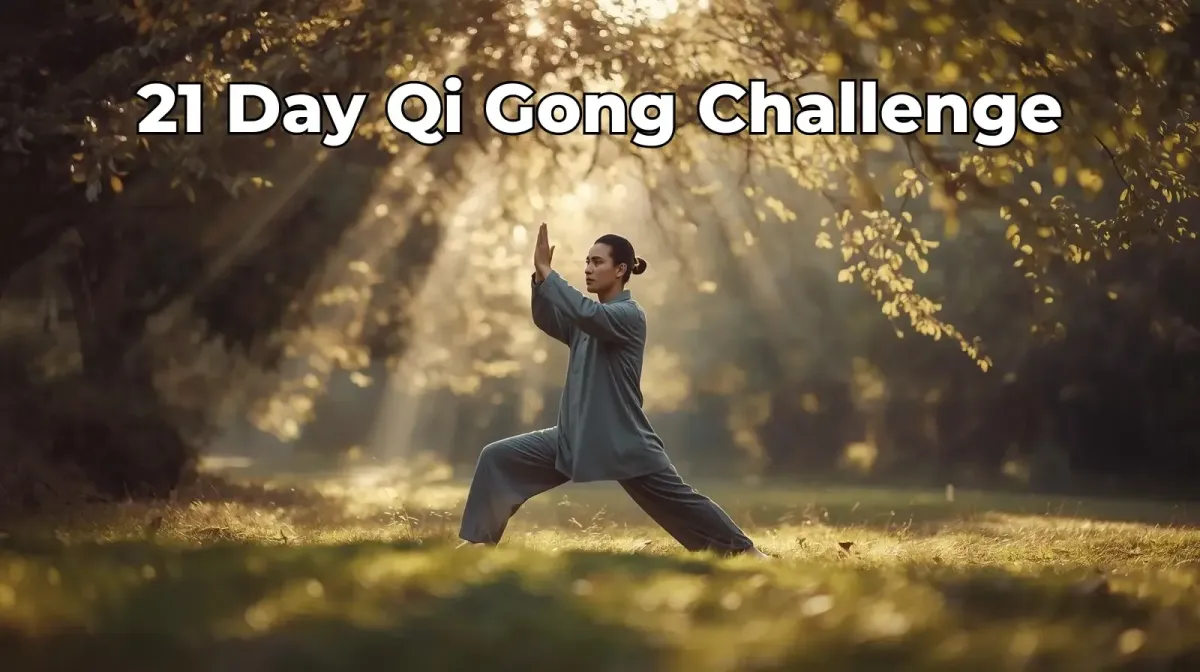
21-Day Qi Gong Challenge: Morning and Evening Practice for Deeper Discipline
The 21-Day Qi Gong Challenge is for people who are ready to take their practice deeper.
This is not a beginner course. It is a focused practice challenge for students who already have some experience of Qi Gong and want to build more consistency, discipline and energy awareness.
For 21 days, you practise twice each day: once in the morning and once in the evening. The morning practice helps you wake the body, gather your energy and begin the day with more presence. The evening practice helps you settle, release the day and return to yourself before rest.
The aim is not to force progress or push your body harder. The aim is to create a steady rhythm that helps your practice become more embodied and reliable.
If you are completely new to Qi Gong, begin with the Free 7-Day Online Qi Gong Course first. If you want a fuller beginner foundation, continue with the 7-Day Qi Gong for Beginners Course.
When you feel ready for a stronger commitment, this challenge can help prepare you for the Intermediate and Advanced Qi Gong Training.
"The 21-Day Qi Gong Challenge is a bridge between beginner practice and deeper training, helping you build the steady rhythm needed for intermediate and advanced Qi Gong."
What Is the 21-Day Qi Gong Challenge?
The 21-Day Qi Gong Challenge is a structured practice journey built around one clear commitment: morning and evening Qi Gong for 21 days.
It is designed to help you move beyond occasional practice and into a steadier rhythm. Instead of practising only when you feel motivated, the challenge gives you a simple container to return to each day.
The morning session helps you wake up the body, bring awareness to your breath and begin the day with more steadiness.
The evening session helps you soften, release the day and settle your energy before rest.
Together, these two practices create a rhythm of activation and release. You begin the day by gathering your energy, and you end the day by coming back to yourself.
This is not about doing more for the sake of it. It is about learning how consistency changes the way you experience your body, breath and energy over time.
Some days will feel easier than others. That is part of the challenge. The aim is not perfection. The aim is to keep returning with patience, honesty and awareness.
"The 21-Day Qi Gong Challenge helps you build a steady morning and evening rhythm, so your practice becomes part of daily life rather than something you only do when it feels easy."
Who This Challenge Is For
This challenge is for people who already have some Qi Gong experience and feel ready for a stronger practice rhythm.
You do not need to be advanced. You do not need to know complicated forms. You do not need perfect technique.
What matters is that you already understand the basics: moving gently, breathing naturally, listening to your body and adapting when needed.
This challenge may be right for you if you have completed a beginner course, attended Qi Gong classes, practised at home for a while, or feel ready to move beyond occasional practice.
It is especially useful if you want to build discipline, deepen energy awareness, strengthen your daily routine and prepare for the Intermediate and Advanced Qi Gong Training.
It may not be the right first step if you are completely new, very depleted, recovering from illness, or not ready for two sessions per day. In that case, start with the Free 7-Day Online Qi Gong Course or the 7-Day Qi Gong for Beginners Course first.
"This challenge is for students who are ready to move from learning the basics into a steadier, deeper and more disciplined Qi Gong practice."
How the Morning and Evening Practice Works
The heart of this challenge is the rhythm of practising twice each day.
Your morning practice is there to help you begin the day with more presence. It helps you wake the body, breathe more fully and bring your awareness inward before the demands of the day begin.
This does not need to be intense. A good morning practice should feel steady and awakening, not rushed or forceful. The aim is to gather your energy, open the body and create a clear starting point for the day.
Your evening practice has a different purpose.
By the end of the day, you may be carrying tension, tiredness, emotional residue or mental activity. Evening Qi Gong gives you a way to soften the body, release what you no longer need to carry and settle your energy before rest.
The morning session helps you rise into the day.
The evening session helps you return from the day.
Together, they create a simple but powerful structure. You are not only practising Qi Gong; you are learning to meet yourself at two important moments each day.
Over 21 days, this rhythm can help you notice how your energy changes, how your body responds, and how your practice supports you differently in the morning and evening.
"Morning practice helps you gather your energy, while evening practice helps you settle, release and return to yourself."
What to Expect Over the 21 Days
The 21 days are not meant to feel the same from beginning to end.
In the first few days, your main task is to establish the rhythm. You are learning how to make space for practice in the morning and evening, even when life feels busy. Keep it simple. Show up, move gently, breathe naturally and notice how you feel.
As the challenge continues, you may begin to meet resistance. This is normal. The mind may say, “I will do it later,” or “I do not have enough time today.” The body may feel tired in the evening or stiff in the morning. This is where the challenge becomes more than physical movement. It becomes a practice of returning.
By the second week, you may begin to understand your patterns more clearly. You may notice whether you push too hard, avoid practice when tired, or expect quick results. This is useful information. Qi Gong teaches steadiness, not pressure.
By the final week, the rhythm may start to feel more natural. You may notice subtle changes in your posture, breath, mood, energy or awareness. These changes may not be dramatic, but they matter. Qi Gong often develops through small shifts that become stronger through repetition.
The most important thing is to stay honest and adaptable. If you need to soften a session, soften it. If you miss one, return at the next one. If your body asks for rest, listen.
The challenge is not about completing 21 perfect days. It is about building a more consistent relationship with your practice.
"Over 21 days, the challenge helps you move from effort into rhythm, and from occasional practice into a steadier relationship with Qi Gong."
Using a Simple Tracker
A simple tracker can make the 21-Day Qi Gong Challenge much more useful.
The purpose is not to judge yourself or turn the practice into a performance. The purpose is to notice what changes as you practise morning and evening.
Each day, you can track whether you completed your morning session and evening session. You can also add a short note about your energy, mood, body state or breath.
You do not need to write a long journal entry. One honest sentence is enough.
For example:
“My body felt stiff this morning, but softer after practice.”
Or:
“I resisted the evening session, but felt calmer once I started.”
You may want to track:
Day number.
Morning practice completed.
Evening practice completed.
Energy before practice.
Energy after practice.
Mood or emotional state.
Body feedback.
One sentence reflection.
At the end of each week, look back gently. Ask yourself what helped you stay consistent, where resistance appeared, and what you noticed in your body, breath or energy.
This turns the challenge into a learning process. You are not just ticking off days. You are beginning to understand your own rhythm.
Your notes can also help you decide whether you are ready to continue into the Intermediate and Advanced Qi Gong Training.
Record Your Morning And Evening Journey
Your course includes a dedicated practice tracker to help you record your morning and evening sessions across the full twenty-one days.
The tracker allows you to notice changes in your body, breathing, energy and emotional state while keeping your reflections together in one place.
It is designed to support gentle consistency without creating pressure around streaks or perfect completion.
Open The 21-Day Qi Gong Practice Tracker
"A tracker helps you notice the quiet changes that happen through steady practice, so the challenge becomes a journey of awareness rather than just a task to complete."
Is This Challenge Suitable for Beginners?
The 21-Day Qi Gong Challenge is not the best first step for complete beginners.
That does not mean beginners should avoid Qi Gong. It simply means this challenge asks for a stronger level of commitment than most new students need at the start.
Practising twice a day can be very supportive when you already understand the basics. However, if you are still learning how to stand, breathe, move gently, soften the body and listen to your energy, it is better to build that foundation first.
If you are new to Qi Gong, begin with the Free 7-Day Online Qi Gong Course. This gives you a gentle introduction to movement, breath and awareness.
After that, the 7-Day Qi Gong for Beginners Course gives you a clearer beginner foundation before moving into a stronger daily challenge.
Once you feel comfortable with the basics, you can return to the 21-Day Qi Gong Challenge with more confidence.
This creates a healthier pathway:
Begin gently.
Build the foundations.
Take the 21-day challenge.
Continue into Intermediate and Advanced Qi Gong Training.
That progression matters. It gives your body time to learn, your confidence time to grow and your practice time to become steady.
"The 21-Day Qi Gong Challenge is best approached after the beginner foundations, so your practice can deepen without becoming rushed or overwhelming."
Final Thoughts
The 21-Day Qi Gong Challenge is a steady commitment to your practice.
It is not about perfection. It is not about pushing yourself harder. It is not about proving that you can complete every session without difficulty.
It is about returning.
For 21 days, you come back to the body in the morning and again in the evening. You breathe, move, notice and listen. Some days may feel clear and energising. Other days may feel slower or more resistant. Both are part of the training.
What matters is the relationship you build with practice.
When you show up consistently, Qi Gong begins to teach you in a deeper way. You start to understand your own rhythms. You notice how your energy changes. You become more aware of what supports you and what drains you.
This is why the challenge can be such a valuable bridge. It helps you move beyond simply knowing about Qi Gong and into a more embodied, disciplined and personal experience of the practice.
"The real value of the 21-Day Qi Gong Challenge is not only completing the days, but discovering how steady practice changes your relationship with your body, breath and energy."
Next Steps
Choose the step that matches where you are now.
If you are completely new to Qi Gong, begin here:
Free 7-Day Online Qi Gong Course
This is the gentlest starting point. It gives you a simple introduction to Qi Gong, with short practices that help you experience movement, breath and awareness without pressure.
If you already know you want a clearer beginner foundation, continue here:
7-Day Qi Gong for Beginners Course
This is the next step after the free course. It gives you more structure, guidance and confidence before moving into a stronger practice rhythm.
If you have some experience and feel ready for the challenge, begin the 21-day practice.
Commit to one morning session and one evening session each day. Use the tracker to stay aware of your progress, but remember that the aim is not perfection. The aim is consistency, awareness and return.
If you complete the challenge and feel ready to go deeper, continue here:
Intermediate and Advanced Qi Gong Training
This is the natural next step after the challenge. It gives you a deeper training pathway with structured lessons, stronger practice foundations and a growing library of Qi Gong practices to support your continued development.
"Begin where you are, build the foundation steadily, and let your Qi Gong practice deepen one step at a time."
Frequently Asked Questions On The 21-Day Qi Gong Challenge
Is the 21-Day Qi Gong Challenge a beginner course?
No. The 21-Day Qi Gong Challenge is not designed as the first step for complete beginners.
It is better suited to people who already have some experience of Qi Gong and feel ready to practise twice each day. If you are new, begin with the Free 7-Day Online Qi Gong Course or the 7-Day Qi Gong for Beginners Course first.
How many times a day do I practise?
The challenge is based on two sessions per day: one in the morning and one in the evening.
The morning session helps you wake the body and begin the day with more awareness. The evening session helps you soften, release the day and settle your energy before rest.
What happens if I miss a session?
If you miss a session, simply return at the next one.
You do not need to punish yourself, double the next practice or give up completely. The deeper lesson is learning how to return with steadiness rather than turning one missed session into a reason to stop.
Do I need to be advanced to take part?
No. You do not need to be advanced, but you should already understand the basics of Qi Gong.
This challenge is suitable if you have completed a beginner course, attended classes, or practised at home and now feel ready for a stronger daily rhythm.
Can I adapt the practices?
Yes. You should always adapt Qi Gong to your body, energy and needs.
You can reduce the range of movement, practise seated, shorten a session, rest when needed or soften the practice if your body asks for it. A deeper practice should make you more aware of your body, not less.
What should I do after the challenge?
After completing the challenge, the natural next step is the Intermediate and Advanced Qi Gong Training.
The challenge helps you build the consistency and awareness needed to enter deeper training with more confidence.
Further Reading
What Is Qi Gong? Origins, Principles and Benefits
A clear guide to the meaning, background and core principles of Qi Gong. This is a helpful place to return to if you want to understand the foundations behind the practice.
Qi Gong Fundamentals: Breath, Movement and Mind Explained
This article explains the three essential pillars of Qi Gong practice. It is especially useful if you want to strengthen your understanding before taking on a deeper challenge.
Morning Qi Gong Routine for Energy, Clarity and Calm
A useful companion article for the morning part of the challenge. It can help you understand how morning Qi Gong supports energy, focus and a steadier start to the day.
Evening Qi Gong Routine: Calm Your Body and Wind Down Naturally
A supportive guide for the evening practice. This is helpful if you want to use Qi Gong to settle the body, release the day and prepare for rest.
How to Learn Qi Gong Online
A practical guide for students who want to build their practice at home. It explains how to approach online Qi Gong training in a steady, grounded and beginner-friendly way.
Intermediate and Advanced Qi Gong Training
The natural next step after the 21-Day Qi Gong Challenge. This training is for students who are ready to deepen their practice with more structure, consistency and a wider library of Qi Gong lessons.
I look forward to connecting with you in my next post.
Until then, be well and keep shining.
Peter. :)