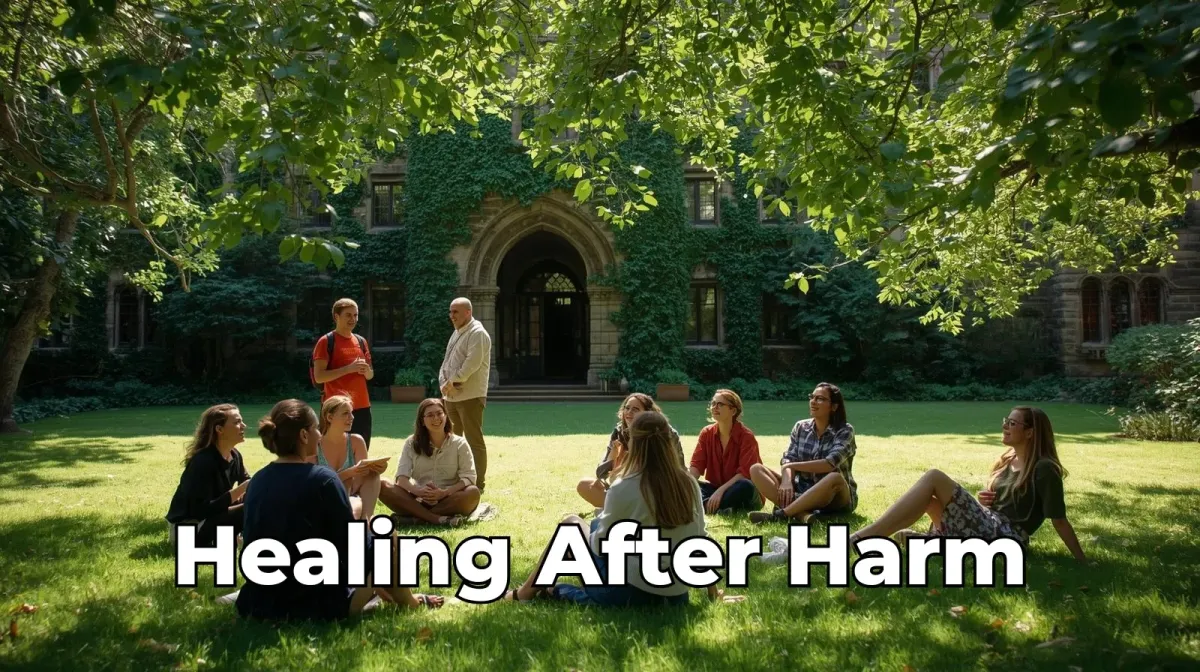
Healing After a Harmful Spiritual Group: A Gentle Re-Entry Guide
Leaving a harmful spiritual group can feel like you’ve walked out of a burning building with no shoes on. On one level, you know you’ve done the right thing. On another, you may feel disorientated, ashamed, angry, grief-stricken or completely numb.
You might miss the good parts – the friendships, the sense of meaning, the ritual – even as you recognise the manipulation or abuse. You might also wonder if you can ever trust any spiritual path again, including Mystery School teachings.
This article is a gentle re-entry guide. It’s not about rushing you back into another group. It’s about helping you:
Understand what might have happened
Soothe your nervous system
Rebuild trust in your own inner compass
Move towards safer, kinder spaces if and when you’re ready
New to mystery schools? Start with our overview article “What Are Mystery Schools?” and then visit the Mystery School hub for classes, courses and next steps.

Naming what happened: spiritual harm and abusive groups
Spiritual harm can take many forms. You might have experienced:
Emotional manipulation – being shamed, gaslit or constantly “diagnosed” as low vibration, in ego, or under attack
Financial exploitation – pressured to keep paying for more courses, initiations or sessions you couldn’t afford
Boundary violations – unwanted touch, forced disclosures, blurred sexual or romantic boundaries
Control of your life – being told who you could see, what you could believe, or how you should spend your time
Often, these things were wrapped in beautiful language – love, truth, awakening, service. That mix of genuine goodness and real harm can be deeply confusing.
You might feel:
Angry one moment and nostalgic the next
Ashamed you “fell for it”
Afraid that you’re now cursed, blocked or off your path
If any of that resonates, please know: none of this makes you foolish or weak. Spiritually abusive systems often target people who are caring, idealistic and willing to do deep inner work.
If you want a broader context for feeling spiritually lost or disillusioned, you may find Spiritually Lost: A Complete Guide a helpful companion to this article.
Your nervous system after leaving a harmful group
Even if no physical violence occurred, your body and nervous system may have taken a significant hit. Common experiences include:
Hypervigilance – always scanning for danger, signs, meanings
Emotional swings – from rage to numbness to grief
Shame spirals – “How did I not see this?”
Sleep issues, headaches, digestive problems or chronic tension
This isn’t a sign that you’re weak. It’s a sign your system has been under pressure. Trauma-aware living is now a spiritual practice in itself.
Gentle support on this side might include:
Simple breath and body practices that help you feel safe enough in your own skin
Step 1: Stabilise before you “process”
It can be tempting to analyse everything at once, binge on cult documentaries, or write long accounts of your experience. There can be a time for that. But the first phase is often much simpler: stabilise.
Stabilising might look like:
Regular meals and sleep, as best you can
Time in nature or quiet, ordinary spaces
Gentle movement like walking or Qi Gong
Limiting contact with people who trigger your nervous system
If you’re drawn to movement-based support, 7-Day Qi Gong for Beginners Course can be a kind way to reconnect to your body without overwhelming it.
You don’t have to make big decisions about “your path” while you’re still shaking. Safety first. Meaning can come later.
Step 2: Untangling shame and self-blame
Most people who leave harmful groups carry a heavy layer of shame:
“How did I not see it?”
“Why did I stay so long?”
“I told other people to join – what have I done?”
From a Mystery School perspective, this is one of the cruellest tricks of abusive systems: they wound you, then convince you it was all your fault.
A kinder, more accurate framing might be:
You were seeking truth, healing and connection
You trusted people who presented themselves as advanced or caring
Your loyalty and sincerity were used against you
This doesn’t erase the consequences, but it restores your dignity. You were not weak. You were devoted. That devotion can still be a gift – once it’s paired with discernment and boundaries.
If self-blame is strong, you might find Spiritual Bypassing: Spot It, Stop It (2025) and Spiritual Numbness: A Gentle Reset Guide helpful reflections.
Step 3: Reclaiming your inner compass
Harmful groups often encourage you to outsource your inner guidance to:
The leader
The group field
Channellings or entities only they can interpret
After leaving, you may distrust your intuition altogether. A gentle re-entry means rebuilding trust in your own perception, very slowly.
Simple ways to practise:
Tiny preferences: Start with small things – what you want to eat, wear, watch. Ask, “What do I actually feel like today?”
Two-minute check-ins: A few times a day, pause and notice: “Do I feel open, tight or numb right now?” without judging it.
Saying small no’s: With trusted people, practise small boundary-setting (“Actually, I’m tired tonight”, “No thanks, not for me”).
Over time, this builds the muscle that was eroded in the group: knowing and acting from your own centre.
For a simple discernment tool around inner dryness vs deeper desolation, you might enjoy Dryness or Desolation? A 2-Minute Check and Gentle Rules for Desolation (Ignatian).
Step 4: Grieving the good as well as the bad
Leaving a harmful group doesn’t mean everything was bad. You may genuinely miss:
Friends and shared rituals
Moments of awe or comfort
Teachings that still resonate
It’s okay – and healthy – to grieve these. You don’t have to rewrite your whole history as fake. You can hold:
“There was real beauty here”
“There was also real harm”
“I choose safety and integrity now”
Grief is not a sign you made the wrong decision. It’s a sign you cared.
Sound and vibration can sometimes reach places words can’t. If you feel drawn, Healing Through Sound, Music and Vibration offers a gentle way to let your system process some of that emotion.
Step 5: When – and whether – to re-enter spiritual spaces
For some people, the kindest thing is a long break from any group or teacher. For others, a healthy space becomes part of their healing. There is no one right answer.
Questions that might help:
“What does my body do when I imagine joining another group? Tighten, soften, go numb?”
“Do I want company right now, or do I mostly need space?”
“If I did step into a new space, what are my non-negotiable red flags and green flags?”
If and when you choose to re-enter, you might begin with:
Very low-commitment, low-cost classes
Groups that centre consent, nervous-system awareness and pacing
Spaces where you can be honest about your history
At Bright Beings Academy, the Spiritual Wellness Class is designed with exactly this in mind – a gentle, grounded space for people who’ve often been through a lot, spiritually and emotionally, and are ready for something kinder.
When you feel ready to explore spiritual teaching again, it can help to understand the signs of ethical mystery school teaching so your next step feels safer, clearer and more grounded.
How this sits in your Mystery School map
This article lives at the intersection of spiritual recovery and Mystery School discernment. It pairs naturally with:
Context and discernment
Mystery School vs Cult: How to Tell the Difference (Gently)
Online Mystery Schools: 7 Red Flags and 7 Green Flags
Is This Online Mystery School Safe? A Trauma-Aware ChecklistDeeper inner process
Dark Night of the Soul in the Mystery School TraditionsRecovery and spiritual confusion
Spiritually Lost: A Complete Guide
Spiritual Numbness: A Gentle Reset Guide
In terms of courses and classes, two particularly gentle options are:
Spiritual Wellness Class – a soft landing place focused on regulation, simple practices and clear boundaries.
Dark Night of the Soul (Course) – if you clearly recognise your experience as a deep spiritual crisis and want a structured, compassionate map.
Next Steps On Your Mystery School Path
If you’ve read this far, I want to honour the courage that takes. Revisiting spiritual harm is not easy. Neither is staying open to the possibility that something wiser and kinder might still be possible.
Your next step does not need to be grand. It might simply be:
Drinking a glass of water and taking three slow breaths
Writing one sentence in your journal about what you’re feeling right now
Looking at the Mystery School hub only if and when it feels safe enough to be curious
If you are exploring mystery school teachings and would like gentle support to find the right next step, you are welcome to complete the Free Soul Reconnection Call / Meraki Guide Questionnaire
If you do feel ready for gentle companionship on the path, you might explore:
The Spiritual Wellness Class as a low-pressure place to rebuild trust in your body and intuition
The Dark Night of the Soul (Course) if your experience feels like a deep dismantling of meaning and identity
Whatever you choose, please remember this: leaving a harmful group was an act of wisdom, even if it still hurts. Your relationship with the sacred belongs to you. No group or teacher can own it.


FAQs — Healing After a Harmful Spiritual Group: A Gentle Re-Entry Guide
Q1) How do I know if my old group was actually “harmful” or if I’m overreacting?
Instead of debating labels, you might ask: “Did my involvement consistently harm my mental, emotional, physical or financial wellbeing?” and “Were my boundaries and concerns respected when I raised them?” If the honest answer is “yes, it harmed me” and “no, I wasn’t respected”, that’s enough to take your experience seriously.
Q2) Should I confront the leader or group now I’ve left?
Sometimes speaking out can be healing and important for others. Sometimes it can be re-traumatising or unsafe. There is no single right answer. It’s wise to check your motives, your safety and your support before deciding. You do not owe anyone a confrontation to validate your choice to leave.
Q3) Is it normal to miss the group even if it was harmful?
Yes. You may miss the good moments, the friends, the shared purpose. Missing those does not mean you should go back. It simply means you are human and capable of love and loyalty. Grieving the loss of community is part of healing, even when leaving was the healthiest choice.
Q4) Can I trust my intuition again after being “wrong” about a group?
Your intuition was likely picking up on genuine goodness as well as potential harm. What needs refining is not your sensitivity, but the context and tools you use to interpret it. Over time, with trauma-aware support and kinder spaces, your inner compass can become clearer and more nuanced.
Q5) How long will it take to heal from spiritual abuse?
Healing isn’t linear and there is no fixed timeline. Some people feel significantly better within months; others process layers over years. What tends to help is steady support, safe relationships, nervous-system care and finding ways to reconnect with what is true and kind for you – without rushing.
Educational note: This article is for learning and wellbeing. It does not replace medical, psychological or legal advice. Please seek qualified professional support if you are struggling to cope, feel unsafe, or are considering action against a group or leader.
I look forward to connecting with you in my next post.
Until then, be well and keep shining.
Peter. :)