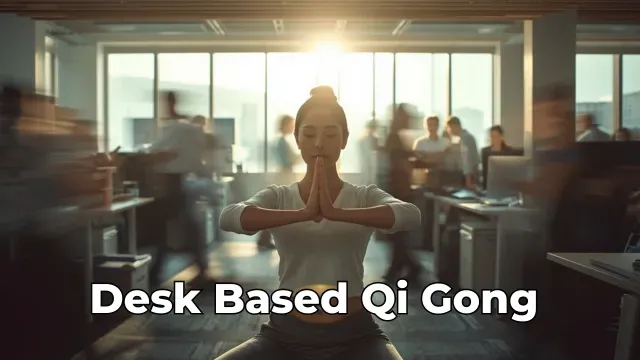
Desk-Based Qi Gong for Office Workers
Desk-based Qi Gong for office workers is a simple practice that combines gentle seated movements, breathing exercises, and mindful awareness to support wellbeing during the working day.
Many employees spend hours sitting at desks, attending meetings, working on computers, and moving from one task to another with little opportunity for physical movement or recovery. Over time, this can contribute to tension, fatigue, reduced concentration, and increased workplace stress.
While many people recognise the importance of exercise, finding time for lengthy wellbeing practices during a busy working day can be difficult.
This is where desk-based Qi Gong can help.
Unlike traditional exercise programmes, desk-based Qi Gong for office workers can be performed while seated or standing beside a desk. The movements are gentle, require no specialist equipment, and can often be completed in just a few minutes.
This makes the practice particularly suitable for modern workplaces where employees need practical wellbeing tools that fit naturally into their day.
Many organisations now include body-based wellbeing approaches within wider workplace wellbeing strategies. Our Corporate Wellbeing hub explores the broader picture of employee wellbeing, while Corporate Wellbeing Workshops shows how practical wellbeing skills can be introduced across teams and organisations.
In this guide, we will explore how desk-based Qi Gong for office workers supports wellbeing, why it is effective in workplace settings, and how employees can use it throughout the working day.
"Desk-based Qi Gong for office workers makes workplace wellbeing more accessible by bringing practical wellbeing skills directly into the working day."
Explore Our Corporate Wellbeing Services
If your organisation is looking to strengthen resilience, improve wellbeing, reduce stress, and create a healthier workplace culture, explore our Corporate Wellbeing Hub.
From workshops and leadership development to nervous system regulation and team wellbeing programmes, you'll find practical solutions designed for modern organisations.
Explore the Corporate Wellbeing Hub

Why Desk-Based Qi Gong for Office Workers Is Becoming More Popular
Modern office work often requires employees to spend long periods sitting, concentrating on screens, attending virtual meetings, and managing multiple demands throughout the day.
While technology has improved efficiency, it has also created new wellbeing challenges.
Many office workers experience physical tension in the neck, shoulders, back, wrists, and hips. Others report mental fatigue, difficulty concentrating, reduced energy levels, and a sense of being constantly switched on.
Traditional workplace wellbeing advice often encourages employees to exercise before or after work. While this advice has value, it does not always help employees manage how they feel during the working day itself.
Desk-based Qi Gong for office workers offers a practical alternative.
Because the exercises can be performed while seated or standing beside a desk, employees can incorporate short wellbeing breaks into their existing routines without needing to leave the office or find specialist facilities.
This makes the practice particularly relevant for hybrid workers, remote teams, customer service staff, administrators, managers, and knowledge workers who spend much of their day at a computer.
The growing interest in desk-based wellbeing practices also reflects a wider understanding that wellbeing is not simply something employees do outside work. It is increasingly recognised as part of how people work.
This aligns closely with the ideas explored in What Is Workplace Wellbeing? and How Do You Promote Wellbeing in the Workplace?, both of which highlight the importance of creating wellbeing opportunities throughout the working day.
"Desk-based Qi Gong for office workers succeeds because it makes wellbeing practical, accessible, and easy to integrate into everyday work routines."
How Desk-Based Qi Gong for Office Workers Supports Physical Wellbeing
One of the most immediate benefits of desk-based Qi Gong for office workers is its ability to encourage gentle movement throughout the day.
Many office roles involve prolonged periods of sitting, often with limited opportunities to change posture or move freely. Over time, this can contribute to feelings of stiffness, tension, and physical discomfort.
Desk-based Qi Gong introduces simple movements that encourage employees to move joints, stretch muscles, improve posture awareness, and reconnect with their bodies.
Common areas of tension for office workers include:
Neck and shoulders
Upper back
Lower back
Wrists and hands
Hips
Legs and feet
Gentle Qi Gong exercises can help employees become more aware of these areas and encourage regular movement breaks throughout the day.
The practice also emphasises slow, controlled movement rather than intense exercise. This makes it accessible to a wide range of employees, including those who may feel intimidated by traditional fitness programmes.
Importantly, desk-based Qi Gong is not intended to replace regular physical activity. Instead, it provides a practical way to reduce prolonged periods of inactivity and encourage movement during working hours.
For organisations seeking realistic wellbeing interventions, this accessibility is one of the reasons desk-based Qi Gong is becoming increasingly popular within workplace wellbeing programmes.
Many employers also find that employees are more likely to engage with wellbeing activities when they can be performed without leaving their desk or disrupting their workflow.
"Desk-based Qi Gong for office workers encourages regular movement and body awareness, helping employees bring wellbeing into the flow of their working day."
How Desk-Based Qi Gong for Office Workers Supports Mental Wellbeing and Focus
Office work can place significant demands on attention and concentration.
Employees are often expected to manage emails, meetings, deadlines, messages, and competing priorities throughout the day. Over time, this constant mental activity can contribute to fatigue, reduced focus, and feelings of overwhelm.
Desk-based Qi Gong for office workers provides an opportunity to interrupt this cycle.
By combining gentle movement with breathing and mindful awareness, employees are encouraged to pause briefly and bring their attention back to the present moment. Even short practices can help create a mental reset between tasks and responsibilities.
Many employees find that they move through their day on autopilot, carrying stress from one meeting into the next. Desk-based Qi Gong creates small moments of awareness that allow employees to check in with themselves before continuing.
This can be particularly valuable during busy periods when people feel pressure to remain productive while managing increasing demands.
The connection between physical movement and mental wellbeing is also explored in Workplace Resilience Starts in the Body and Emotional Regulation for Employees: A Practical Workplace Guide.
Rather than viewing focus as purely a mental skill, these approaches recognise that physical tension, breathing patterns, and nervous system state can all influence how effectively employees think, communicate, and perform.
For many office workers, a few minutes of desk-based Qi Gong may provide a valuable opportunity to reset attention before returning to important tasks.
"Desk-based Qi Gong for office workers helps create small moments of mental recovery that support focus, awareness, and sustainable performance."
The Connection Between Desk-Based Qi Gong for Office Workers and Workplace Stress
Workplace stress is not always caused by major events.
Often, it develops gradually through the accumulation of small pressures throughout the day. Back-to-back meetings, constant notifications, demanding workloads, interruptions, and long periods of concentration can all contribute to rising stress levels.
Many employees do not notice how much tension they are carrying until they feel exhausted, overwhelmed, or unable to concentrate effectively.
Desk-based Qi Gong for office workers helps create regular opportunities to recognise and release some of this tension before it accumulates.
Simple breathing exercises can encourage employees to slow down and reconnect with the present moment. Gentle movements can help interrupt physical patterns associated with prolonged sitting and stress.
These practices are particularly useful because they can be performed within the working environment itself.
Employees do not need to wait until the end of the day to support their wellbeing. Instead, they can build small moments of recovery into their normal routines.
This approach aligns closely with the principles explored in What Is Nervous System Regulation at Work? and Why Stress Management Often Fails in the Workplace.
Both articles highlight an important reality: managing workplace stress requires more than understanding stress. Employees also need practical tools that can be used when pressure is actually occurring.
Desk-based Qi Gong provides one way of developing these practical skills.
"Desk-based Qi Gong for office workers helps transform stress management from a theory into a practical daily habit."
What Makes Desk-Based Qi Gong for Office Workers Different from Other Desk Exercises?
Many workplace wellbeing programmes encourage employees to stand up, stretch, or take regular movement breaks.
These activities can be beneficial, but desk-based Qi Gong for office workers offers something slightly different.
Rather than focusing solely on physical movement, Qi Gong combines movement, breathing, and awareness into a single practice. This creates an opportunity to support both physical and mental wellbeing at the same time.
For example, a simple shoulder roll becomes more than just a stretch when combined with conscious breathing and mindful attention. Employees are encouraged to notice how they feel, where they are holding tension, and how their energy levels change throughout the day.
This awareness is an important part of the practice.
Many office workers spend much of their day reacting to external demands. Emails arrive, meetings begin, deadlines approach, and attention is continually pulled in different directions.
Desk-based Qi Gong provides a brief opportunity to pause and reconnect with what is happening internally.
Another advantage is accessibility.
Most exercises can be adapted for different physical abilities and workplace environments. Employees do not need changing facilities, specialist equipment, athletic clothing, or previous experience.
This makes desk-based Qi Gong particularly attractive for organisations seeking wellbeing activities that can be adopted across diverse workforce groups.
When integrated into wider workplace wellbeing initiatives, these small practices can help create a culture where wellbeing becomes a regular part of the working day rather than something employees only think about occasionally.
"Desk-based Qi Gong for office workers combines movement, breathing, and awareness to create a more complete approach to workplace wellbeing."
Practical Ways to Use Desk-Based Qi Gong for Office Workers Throughout the Day
One of the greatest strengths of desk-based Qi Gong for office workers is its flexibility.
Employees do not need to set aside large blocks of time or wait for a formal wellbeing session. Many of the techniques can be integrated naturally into the working day whenever they are needed.
For example, a short breathing exercise before an important presentation may help an employee settle their attention and prepare more effectively. Gentle shoulder and neck movements between meetings can help reduce physical tension that has accumulated during periods of concentrated work.
Some employees find it helpful to use desk-based Qi Gong as part of a regular routine, while others use it during particularly demanding periods of the day.
Common opportunities include:
Before starting work in the morning
Between meetings
Before presentations
After difficult conversations
During lunch breaks
Following long periods of screen time
At the end of the working day
During periods of increased workload
These brief practices may only take a few minutes, but they can help employees create moments of recovery that are often missing from busy working schedules.
Many organisations find that employees are more likely to engage with wellbeing initiatives when they are practical and easy to implement. Desk-based Qi Gong supports this by removing many of the barriers that prevent people from participating in workplace wellbeing activities.
This practical approach also complements the ideas discussed in 15 Workplace Wellbeing Initiatives That Employees Actually Use and Breathwork for Workplace Stress: Simple Techniques for Busy Teams.
"Desk-based Qi Gong for office workers works best when wellbeing becomes part of the day rather than another task on the to-do list."
What Are the Benefits of Desk-Based Qi Gong for Office Workers?
The benefits of desk-based Qi Gong for office workers extend beyond simply encouraging people to move more during the working day.
Because the practice combines movement, breathing, and awareness, it can support multiple aspects of workplace wellbeing at the same time.
For employees, desk-based Qi Gong may help create opportunities for physical movement, mental recovery, and improved self-awareness. Many office workers appreciate that the techniques are simple, practical, and can be used without leaving their workstation.
For managers and leaders, the practice can provide a useful way to encourage healthier working habits and demonstrate that wellbeing is valued within the organisation.
For organisations, desk-based Qi Gong can support wider wellbeing objectives by making wellbeing more accessible and easier to integrate into daily work routines.
Potential benefits may include:
Increased movement during sedentary working days
Greater awareness of physical tension
Improved focus and concentration
More opportunities for recovery between tasks
Better engagement with workplace wellbeing initiatives
Practical support for workplace stress management
Improved awareness of personal wellbeing habits
Importantly, desk-based Qi Gong is not intended to replace wider wellbeing strategies. Instead, it works best when combined with supportive leadership, healthy workplace cultures, and broader wellbeing initiatives.
This aligns with the principles explored in What Should Be Included in a Workplace Wellbeing Strategy? and How Do You Measure Wellbeing in the Workplace?.
The greatest benefit may be that employees leave with practical techniques they can continue using independently throughout their working lives.
"Desk-based Qi Gong for office workers helps transform wellbeing from an occasional activity into a practical daily habit."
Related Workplace Wellbeing Resources
If you would like to explore additional ways to support workplace wellbeing, employee resilience, and stress management, these resources may be helpful:
Corporate Qi Gong Workshops for Employee Wellbeing — Discover how structured Qi Gong workshops can support workplace wellbeing and employee resilience.
Qi Gong for Workplace Wellbeing: A Practical Guide — Learn how Qi Gong supports workplace wellbeing, focus, and employee health.
Qi Gong for Workplace Stress and Employee Resilience — Explore how Qi Gong can help employees manage pressure and build resilience.
Breathwork for Workplace Stress: Simple Techniques for Busy Teams — Discover practical breathing techniques that employees can use throughout the working day.
Workplace Resilience Starts in the Body — Understand why resilience is closely linked to physical wellbeing and recovery.
How the Bright Beings Academy Supports Desk-Based Qi Gong for Office Workers
At the Bright Beings Academy, we believe workplace wellbeing should fit the realities of modern working life.
Many employees spend long hours at desks, move between meetings with little recovery time, and struggle to find practical wellbeing activities that can be used during the working day. This is one reason desk-based Qi Gong has become an increasingly popular part of our workplace wellbeing offering.
Our approach focuses on teaching simple, accessible techniques that employees can use in real workplace situations.
Rather than requiring specialist equipment, dedicated exercise spaces, or lengthy practice sessions, desk-based Qi Gong helps employees develop practical wellbeing skills that can be integrated into existing routines.
Many organisations introduce these techniques through our Corporate Wellbeing Workshops, where employees learn simple breathing, movement, and recovery practices designed specifically for workplace environments.
For organisations seeking longer-term support, our Corporate Wellbeing Programmes help embed wellbeing into workplace culture through structured and sustainable wellbeing initiatives.
Desk-based Qi Gong also complements our Nervous System Regulation at Work programmes by helping employees understand how physical tension, breathing patterns, and stress responses influence wellbeing and performance.
Whether delivered online or in person, our goal is to provide practical tools that employees can continue using long after the workshop has finished.
"Desk-based Qi Gong for office workers becomes most effective when small daily practices are supported by a wider culture of workplace wellbeing."
Final Thoughts
Modern office work places significant demands on both the body and mind.
Long periods of sitting, constant screen use, busy schedules, and increasing workloads can make it difficult for employees to prioritise their wellbeing during the working day.
Desk-based Qi Gong for office workers offers a practical solution.
By combining gentle movement, breathing exercises, and mindful awareness, employees can create short moments of recovery without leaving their desk or disrupting their workflow. These small practices may seem simple, but they can help employees become more aware of their wellbeing and develop healthier responses to workplace pressure.
One of the greatest strengths of desk-based Qi Gong is its accessibility. Employees do not need specialist equipment, athletic ability, or large amounts of time. The techniques can be adapted to different workplaces, different roles, and different levels of experience.
For organisations, desk-based Qi Gong can complement wider workplace wellbeing initiatives by providing employees with practical skills they can apply immediately. When combined with supportive leadership, healthy workplace cultures, and effective wellbeing strategies, these practices can contribute to a more resilient and engaged workforce.
Ultimately, workplace wellbeing is not built through occasional interventions. It develops through small, consistent actions that employees can realistically maintain over time.
Support Your Workplace Wellbeing Journey
Supporting employee wellbeing does not always require large-scale interventions.
Sometimes the most effective changes come from giving people simple, practical tools they can use throughout the working day. Desk-based Qi Gong is one example of this approach, helping employees build small moments of movement, recovery, and awareness into their existing routines.
At the Bright Beings Academy, we support organisations through practical workplace wellbeing solutions that can be adapted to different teams, working environments, and organisational goals.
If you are looking to strengthen workplace wellbeing, these services may be a useful next step:
Corporate Wellbeing — Discover our approach to employee wellbeing, workplace resilience, and organisational wellbeing.
Corporate Wellbeing Workshops — Explore practical wellbeing workshops covering stress management, resilience, breathwork, emotional wellbeing, and Qi Gong.
Corporate Wellbeing Programmes — Learn how structured wellbeing programmes can support long-term cultural and behavioural change.
Leadership and Team Wellbeing — Support leaders and teams with practical wellbeing strategies that improve resilience, communication, and performance.
Nervous System Regulation at Work — Understand how stress affects employees and learn practical approaches that support regulation, recovery, and resilience.
Whether you are planning a wellbeing event, employee wellbeing programme, leadership development initiative, or workplace resilience strategy, desk-based Qi Gong can provide employees with practical skills they can use every day.

Frequently Asked Questions About Desk-Based Qi Gong for Office Workers
What is desk-based Qi Gong for office workers?
Desk-based Qi Gong for office workers is a workplace wellbeing practice that combines gentle seated or standing movements, breathing exercises, and mindful awareness. It is designed to help employees support their wellbeing during the working day without needing specialist equipment or large amounts of space.
How does desk-based Qi Gong for office workers help reduce workplace stress?
Desk-based Qi Gong for office workers helps reduce workplace stress by encouraging employees to pause, move, breathe, and become more aware of physical tension. These simple practices can create moments of recovery throughout the working day and help employees develop healthier responses to pressure.
Can desk-based Qi Gong for office workers be performed while sitting at a desk?
Yes. Many desk-based Qi Gong exercises for office workers can be performed while seated. This makes the practice particularly useful for employees who spend long periods working at computers or attending meetings.
What are the benefits of desk-based Qi Gong for office workers?
Desk-based Qi Gong for office workers may support physical movement, posture awareness, concentration, stress management, and overall workplace wellbeing. Many employees find that the exercises provide a practical way to break up long periods of sitting.
Is desk-based Qi Gong for office workers suitable for beginners?
Absolutely. Desk-based Qi Gong for office workers is designed to be accessible to people of all ages, fitness levels, and experience levels. No previous experience is required.
How often should office workers practise desk-based Qi Gong?
Office workers can benefit from practising desk-based Qi Gong throughout the day. Many people find that short sessions lasting just a few minutes between meetings or tasks are easier to maintain than longer sessions performed less frequently.
Can desk-based Qi Gong for office workers improve focus and concentration?
Desk-based Qi Gong for office workers may help improve focus and concentration by creating opportunities for mental recovery and reducing the effects of prolonged physical tension. Many employees use the exercises as a reset between demanding tasks.
Can desk-based Qi Gong for office workers be included in workplace wellbeing programmes?
Yes. Desk-based Qi Gong for office workers works particularly well within broader workplace wellbeing initiatives. It can complement resilience training, stress-management programmes, leadership development, and nervous system regulation workshops.
Is desk-based Qi Gong for office workers suitable for remote and hybrid teams?
Yes. Desk-based Qi Gong for office workers can be delivered both in person and online, making it suitable for office-based employees, remote workers, and hybrid teams.
What makes desk-based Qi Gong for office workers different from traditional desk exercises?
Desk-based Qi Gong for office workers combines movement, breathing, and awareness rather than focusing on physical stretching alone. This creates a more holistic approach that supports both physical and mental wellbeing during the working day.
Further Reading
What Is Workplace Wellbeing? A Complete Guide for Employers — Learn the foundations of workplace wellbeing and why it matters for employees, leaders, and organisations.
How Do You Promote Wellbeing in the Workplace? — Discover practical ways to encourage healthier workplace habits and stronger employee engagement.
15 Workplace Wellbeing Initiatives That Employees Actually Use — Explore workplace wellbeing activities that employees are more likely to engage with and maintain.
What Should Be Included in a Workplace Wellbeing Strategy? — Understand the key components of an effective workplace wellbeing strategy.
What Is Nervous System Regulation at Work? — Learn how stress affects the nervous system and why recovery matters for workplace wellbeing.
Why Stress Management Often Fails in the Workplace — Explore why awareness alone is often insufficient and why practical wellbeing skills matter.
Workplace Resilience Starts in the Body — Discover how physical wellbeing influences resilience, focus, and performance.
Breathwork for Workplace Stress: Simple Techniques for Busy Teams — Learn simple breathing techniques that employees can use throughout the working day.
Qi Gong for Workplace Wellbeing: A Practical Guide — Explore how Qi Gong can support workplace wellbeing, resilience, and employee health.
Qi Gong for Workplace Stress and Employee Resilience — Understand how Qi Gong can help employees manage pressure and develop practical resilience skills.
I look forward to connecting with you in the next post.
Until then, be well and keep shining.
Peter. :)